
Air Duct Cleaning What It Really Costs: What Nashville Homeowners Pay in 2026
Air duct cleaning in Nashville typically runs $350 to $700 for a standard home in 2026, and $700 to $1,200 when the system is large, hard to reach, or has never been serviced. The single biggest variable is not the price itself but what kind of cleaning you’re buying. A $99 ad and a $900 quote are both real prices for two very different jobs, and once you understand the math, the gap stops looking mysterious.
Why the Same Job Quotes at $99 and at $900
Start with time. A company running a $99 special is budgeting roughly 45 minutes per job. A thorough mechanical cleaning on a 2,000 square foot home takes three to four hours minimum once you account for setup, contact cleaning of every run, and documentation. That difference in labor time alone explains most of the price gap, and it tells you exactly what you’re buying at each end of the market.
Here’s what actually drives the number on a real Nashville quote:
- Square footage and vent count. More supply and return vents mean more runs to clean, more time, and more equipment cycles.
- Duct material. Sheet metal cleans quickly. Flexible duct needs gentler handling and often takes longer. Ducts with heavy buildup or prior pest activity add hours.
- System accessibility. A ranch with an open crawlspace is a very different job from a two-story with a tight mechanical closet and long trunk runs in a finished ceiling.
- Equipment class. This is the one homeowners underestimate most, and we’ll get into it below.
Nashville’s housing stock runs the full range. Newer builds out toward the edges tend to have simpler layouts. Older homes closer in often have retrofitted systems, added returns, and crawlspaces that make access slower. None of that is a trick; it’s just time, and time is what you’re paying for.
Truck-Mounted vs. Portable Units: What the CFM Difference Means
Truck-mounted vacuum systems pull far more air, measured in cubic feet per minute, than portable units. Higher CFM means the loose debris released by mechanical agitation actually gets pulled out of the system and into the collection unit instead of settling back into the ducts. That’s the whole point of the job.
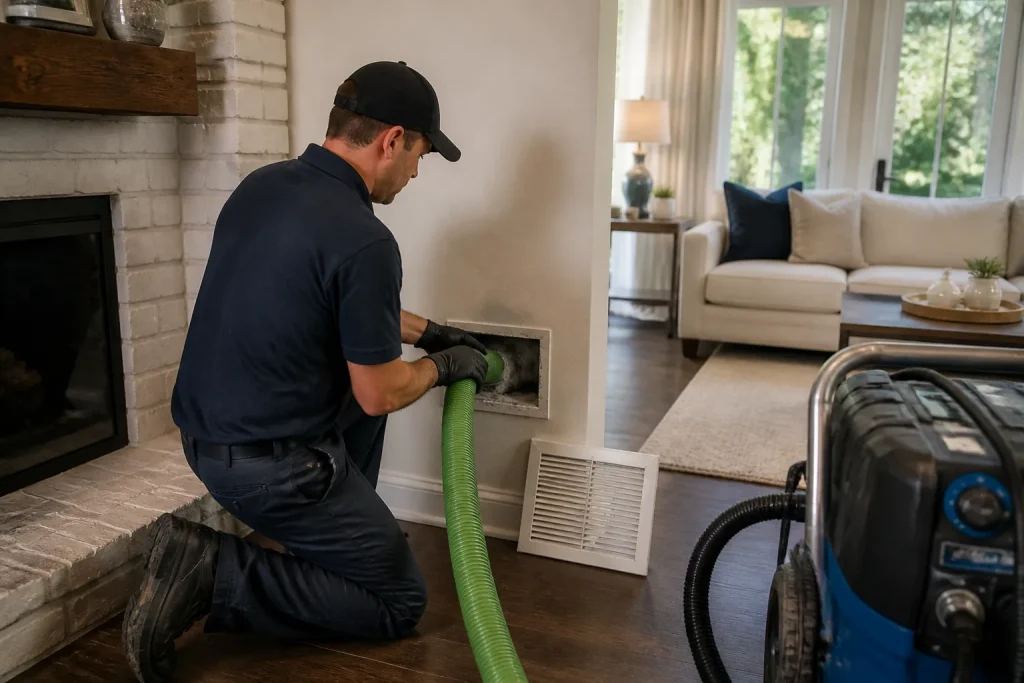
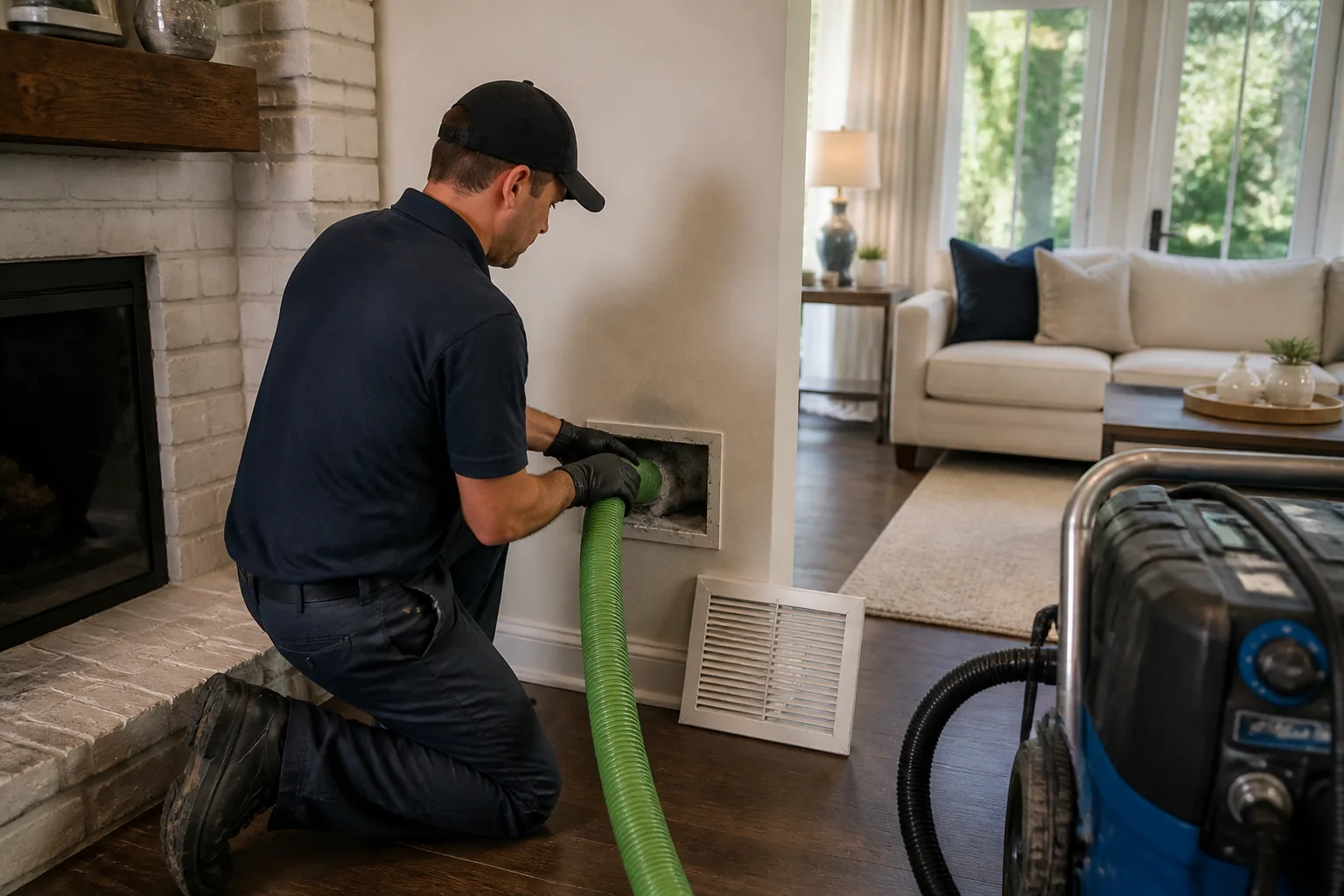
Most cleaning rigs pair a high-CFM vacuum with contact agitation: a rotary brush system that physically scrubs the duct walls, plus hand tools for registers and tight turns. We run a Rotobrush contact-cleaning setup and Nikro cleaning tools on every job, and for homes with mold concerns, post-construction dust, or occupants with respiratory sensitivities we bring in Abatement Technologies filtration equipment. That’s the same category of equipment used in professional remediation work, and it’s a meaningful step above a shop vacuum and a hose.
Here’s the plain version: a low-CFM portable unit can knock loose surface dust. It cannot reliably remove the adhered layer that builds up over years. If a quote doesn’t tell you what equipment is coming into your house, that’s the first question to ask.
What Pushes a Job to the High End
Most Nashville homes land in the middle of the range. These are the factors that move a job upward, and each one is a legitimate reason, not an upsell.
- Heavy contamination. Long intervals since the last cleaning, recent renovation dust, or visible buildup at the registers all add time.
- Many small returns instead of one large one. Each return is its own run to clean and document.
- Duct repair found mid-job. Disconnected joints, crushed flex sections, and leaking seams are common, especially in older construction. When we open a system and find that air is escaping before it reaches the room, the fix belongs in the same visit rather than a second appointment. That capability is why our air duct repair work is done by our own team, not handed off.
- Confirmed mold cases. These call for sanitization and the higher-grade filtration equipment. Sanitization only makes sense when there’s actual microbial growth, not as a routine add-on.
Square footage sets the floor. Condition and access set where in the range the job lands.
Legitimate Add-Ons vs. Upsells That Rarely Add Value
Some add-ons earn their price. Others are padding. Here’s how we draw the line.
Worth it:
- Dryer vent cleaning. A clogged dryer vent is a fire risk and restricts appliance performance. It’s a real safety service, and it can be done as a standalone visit if your ducts are already clear.
- Sanitization, when contamination is confirmed. On a documented mold or microbial issue, treatment is appropriate. On a clean system, it’s a spray with no measurable benefit.
- Air quality upgrades. If you want filtration or humidity control after the ducts are clean, systems from Honeywell and Aprilaire are the ones we work with and around. Those are genuine improvements, separate from the cleaning itself.
Usually not worth it: fogging treatments on a system with no confirmed growth, perfume-style deodorizers that mask rather than remove, and any chemical application nobody can explain to you in plain terms. If a technician can’t tell you why a treatment applies to your house specifically, it probably doesn’t.
Red Flags in Low-Ball Nashville Quotes
Not every cheap quote is dishonest. Some are simply a smaller service. But these are the patterns that tell you a price will change after the technician is on site.
- Bait-and-switch on vent count. The advertised price covers a handful of vents; your home has more; the price climbs once the equipment is inside.
- Unitemized invoices. You can’t see what you paid for. A proper quote breaks out the scope before work starts.
- No before-and-after documentation. A company that photographs your own ducts before and after has nothing to hide. One that doesn’t leaves you taking the work on faith.
- Price quoted over the phone without asking about your home. Vent count and access determine time, and time determines price. A confident number without a single question is a guess.
- No written estimate. One flat price per system, agreed before work starts, is the standard worth holding companies to.
We clean ducts, dryer vents, and repair duct systems across Nashville, and the quotes we’re asked to beat are almost always missing scope rather than margin.
A Realistic 2026 Price Range for Nashville Homes
These are typical ranges, and your written estimate sets the final price. We don’t quote per vent, because a whole-system price is what you actually need to compare.
- Condos and smaller homes, roughly 1,000 to 1,500 square feet: generally $350 to $500.
- Standard single-family homes, 1,500 to 2,500 square feet: typically $450 to $700.
- Larger homes, 2,500 to 3,500 square feet, or systems with many runs: commonly $650 to $1,000.
- Heavy contamination, difficult access, or substantial duct repair: often $900 to $1,200 or more.
- Dryer vent cleaning as a standalone service: generally a modest line item next to the duct work, priced on its own.
When you compare quotes, compare scope: vent count, equipment, time on site, and documentation. Two numbers that look different often describe different jobs. If you want a straight answer on your own house, see what our air duct cleaning visits include before you call a competitor’s $99 ad.
When It’s Time to Call a Pro
Some signs you can check yourself. Visible dust streaking at the registers, a musty smell when the system kicks on, or noticeably weak airflow from some rooms and not others all point to a duct problem worth a professional look. If there’s been a renovation in the house, or it’s been many years since the ducts were serviced, a cleaning is overdue.
One thing we want to be clear about: duct repair and anything involving the air handler should be handled by a trained technician. Crawlspaces and attic runs are cramped, and flex duct tears easily. That’s not a job for a homeowner and a rented vacuum.
If you’d rather skip the guesswork, dryer vent cleaning and duct inspections can both be booked in a single visit, and we’ll tell you what we find before anything changes. Prefer to start with the basics? Our duct cleaning Nashville page walks through the process from the first walkthrough. Use Honeywell or Aprilaire thermostats and filters? We’re familiar with those systems and can recommend air quality upgrades after the ducts are clean, without turning your visit into a sales pitch.
The Bottom Line
In 2026, Nashville homeowners should expect to pay somewhere between $350 and $700 for a standard duct cleaning, with larger, dirtier, or more complicated systems pushing into four figures. The number that matters isn’t the lowest one you’re quoted; it’s the scope behind it. Whole-system pricing, one flat price agreed before work starts, named equipment, and before-and-after photos of your own ducts are the four things that separate a real cleaning from a cheap visit that stirs the dust around.
Our technicians have up to 9 years of experience, and every visit covers your ducts, your dryer vent if you want it, and any repairs found along the way. If you’re in Nashville and need help, Duct Cleaning Nashville offers free estimates. Call (855) 473-8488. We answer 24/7. Fast dispatch from 7am to 7pm, Sunday through Friday.
Frequently Asked Questions
Most Nashville homes fall between $350 and $700 for a standard cleaning, and $700 to $1,200 for larger systems or jobs that involve heavy contamination or duct repair. The written estimate sets the final price. Call (855) 473-8488 for an exact quote. Estimates are free.
Cheap quotes usually buy less time and lighter equipment. A $99 special is often a 45-minute visit with a portable unit, while a real cleaning on a 2,000 square foot home takes three to four hours with professional-grade equipment. Ask what’s included, how many vents, and how long the technician will be there. Call (855) 473-8488 to compare scope, not just price.
Ask for before-and-after photos of your own ducts, plus an itemized scope of what was cleaned. A company with nothing to hide will hand both over without being asked twice. Call (855) 473-8488 if you’d like to see what that documentation looks like.
For most homes, every three to five years is a reasonable interval, and sooner after a renovation, after moving into a house with an unknown service history, or if anyone in the home has allergy or asthma concerns. Homes with pets or heavy dust tend to need it on the shorter end. Call (855) 473-8488 and we’ll help you figure out where your home stands.
Written by the team at Duct Cleaning Nashville.
Need Air Duct Cleaning Help?
Call Duct Cleaning Nashville - licensed & insured, with free written estimates in Nashville.
(855) 473-8488